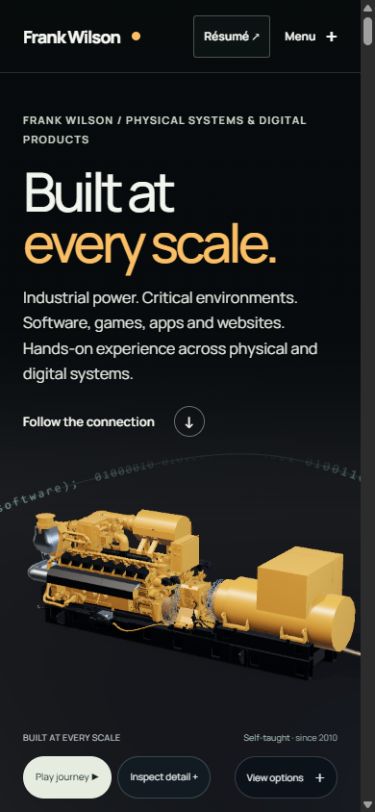
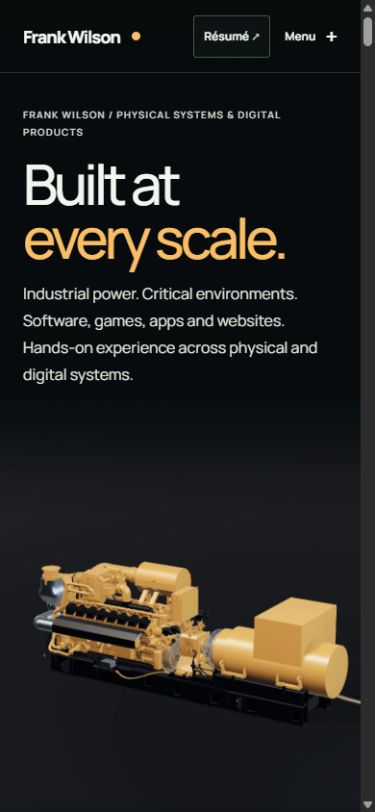


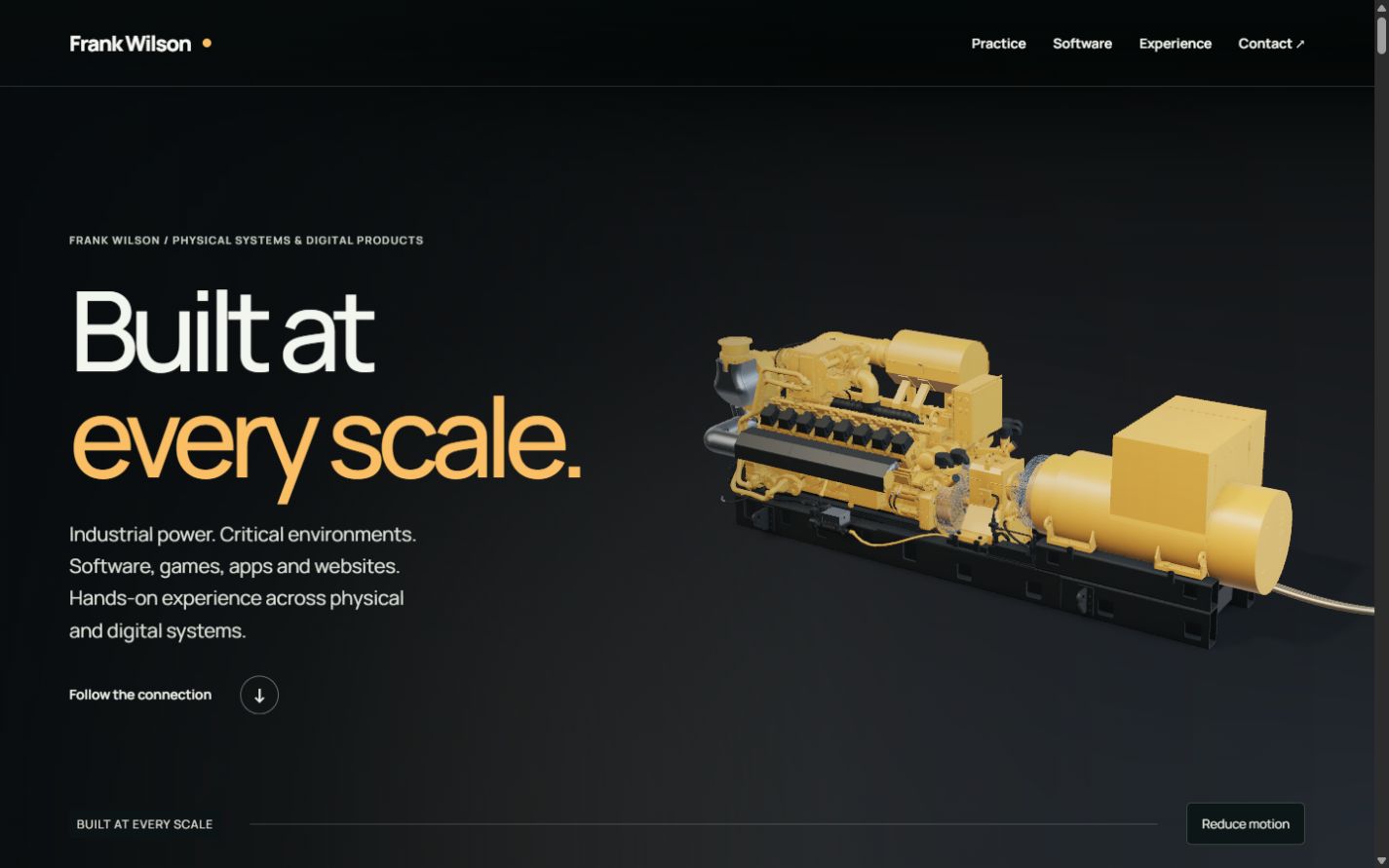
Built at every scale.
One continuous journey.
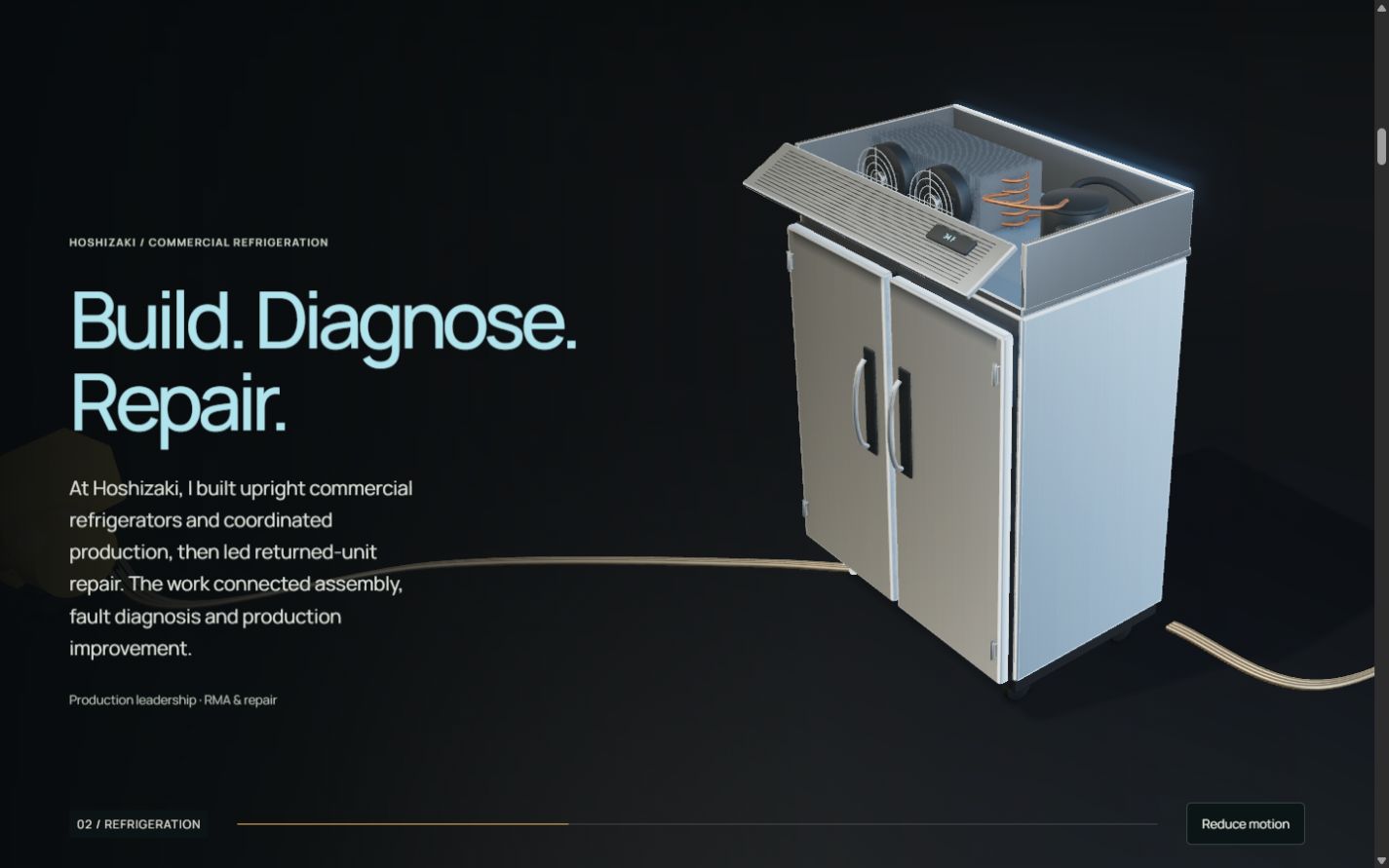
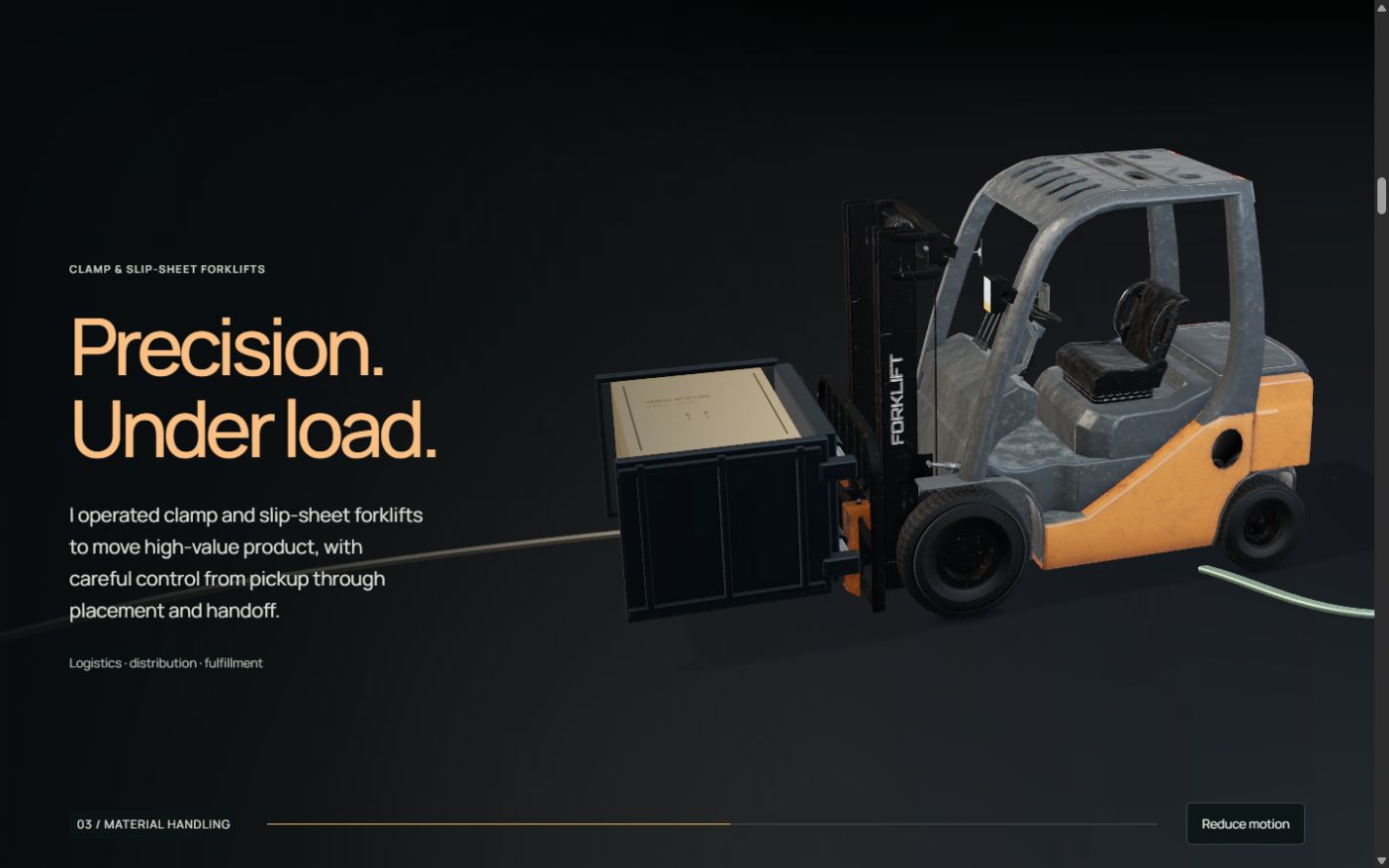
Industrial power. Top-mounted refrigeration. Specialized material handling. Liquid-cooled compute. An established software practice. The selected sequence illustrates areas of practice; equipment models do not document individual workplace installations.
Responsive text and structure
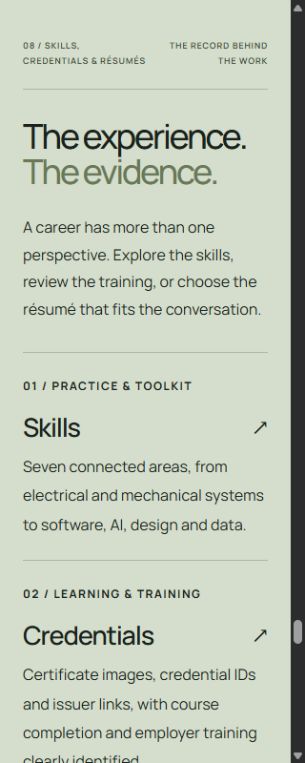
A focused screen-layout pass refines narrow headings, stable career rows, certificate proportions and long dialog titles. Checks cover twelve widths from 320 to 1440 pixels, project tabs and disclosures, credential images and IDs, and all eight résumé views. The 28 printed résumé pages remain pixel-identical to the prior verified output. These are desktop Chromium checks, not physical-phone or other-browser certification.
A background software practice
A restrained strand of code and binary follows the equipment, marking the self-taught development practice that continued alongside the career. It uses the existing camera clock and rests during reading intervals. On phones, lower contrast, depth occlusion and a clear reading area keep the models in front. Its final line resolves into the footer and is echoed in the software section.
A nonmodal preparation panel reports actual loading milestones. The portfolio remains available immediately; playback waits for full scene preparation. View options includes an optional, dismissible portrait-phone suggestion for a wider composition. It never forces rotation or promises better frame rates.
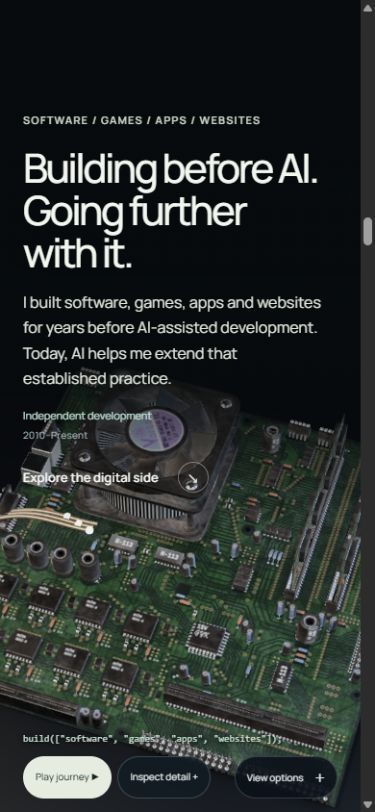
Final content and interaction refinement
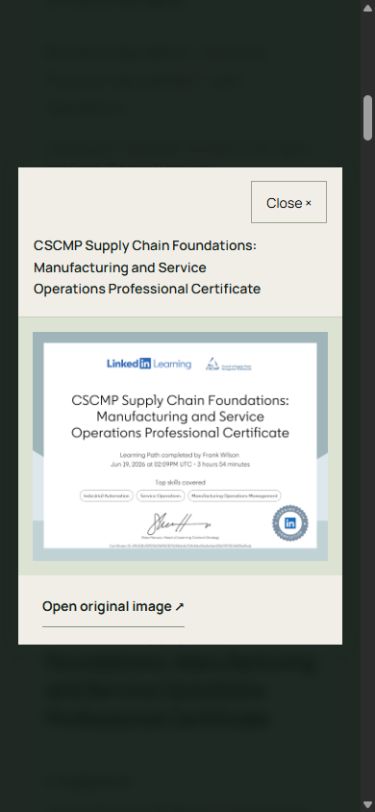
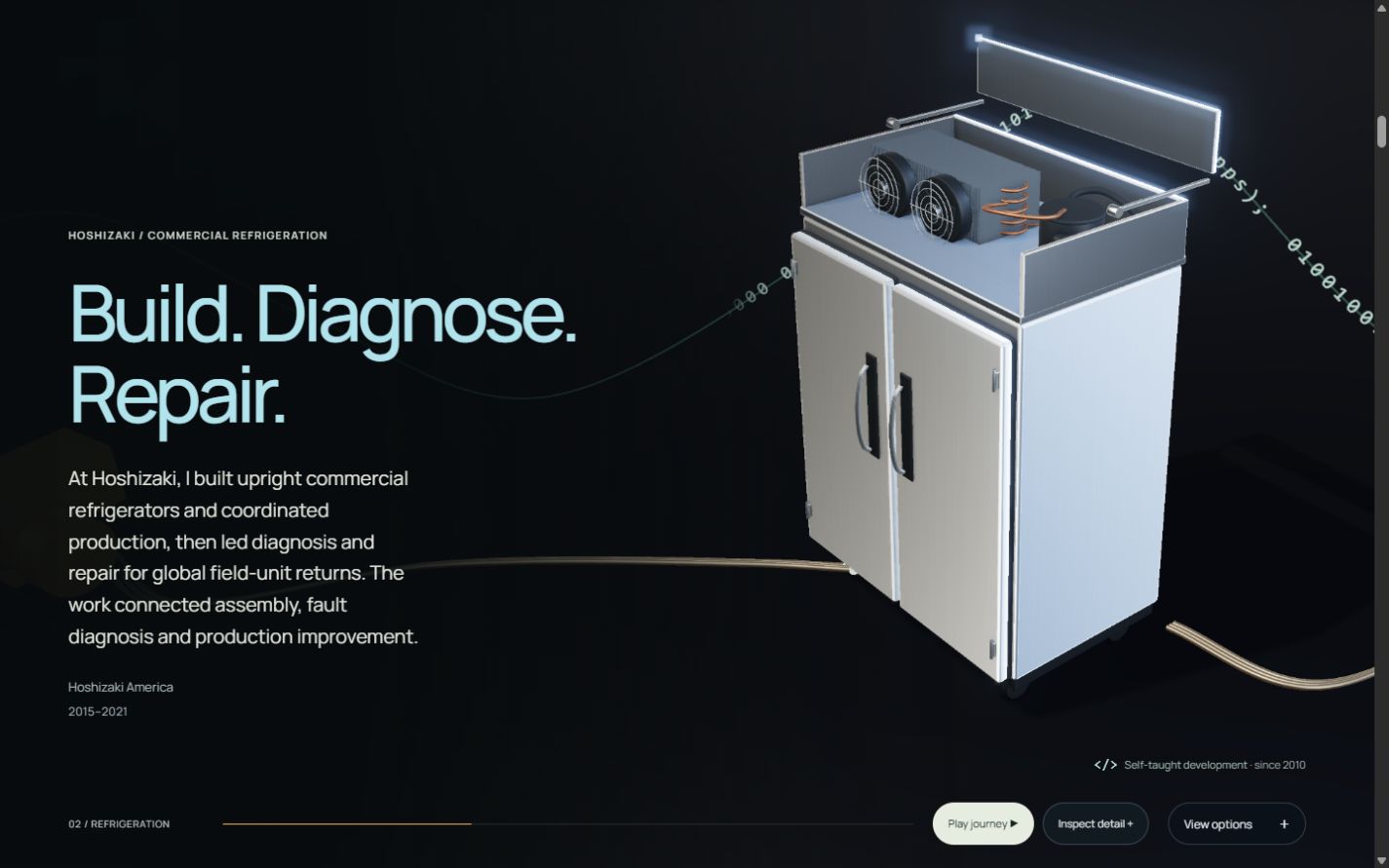
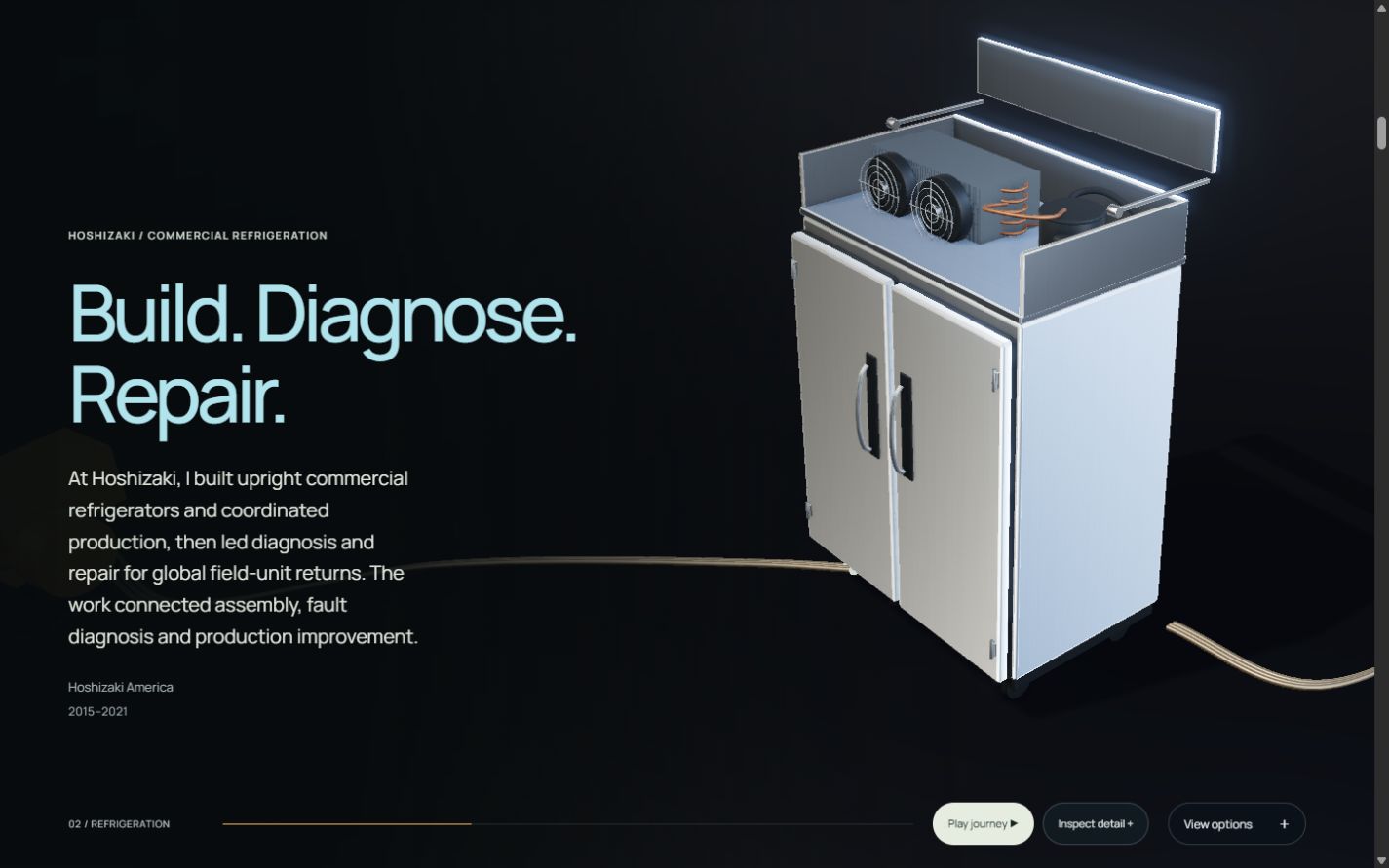
The selected route now has coordinated chapter copy and employment years, opt-in Play/Pause/Resume/Restart, chapter selection and reversible equipment inspection. The refrigerator front panel travels up and behind the condenser. The two new professional certificates appear with their original images and exact printed records. Rack & Role links to its actual archived homepage, with sixteen explanatory stages and an on-demand, twenty-page case-study viewer.

63 automated tests, source verification and all eight browser-generated résumé PDFs passed their corresponding checks. Repeated synthetic phone-workload runs remained near 17 ms p95 frame intervals on this workstation. Physical Galaxy S24 performance, Safari/Firefox coverage and final visual approval remain separate qualifications. Cat use follows the owner's explicit decision under the uploader-declared CC BY license; upstream permission is still unverified.
Preserved previous public checkpoint — craft and phone rendering
The selected design now has stronger studio light separation, refined surface response, compact hanging service loops, a wider phone view of the clamp and its load, and quieter View options controls. Phone geometry is optimized against explicit error limits; original desktop assets and earlier studies remain preserved.
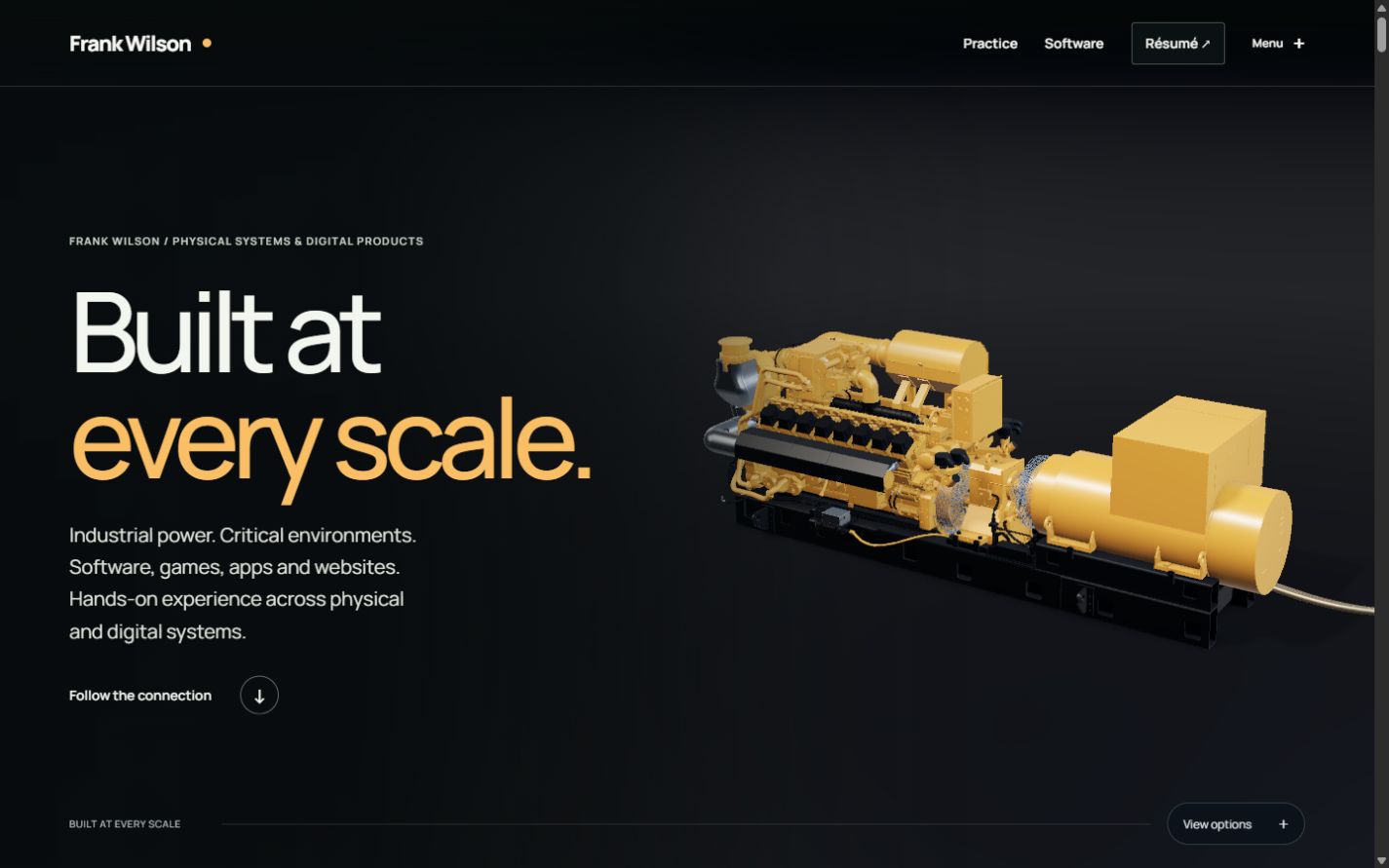
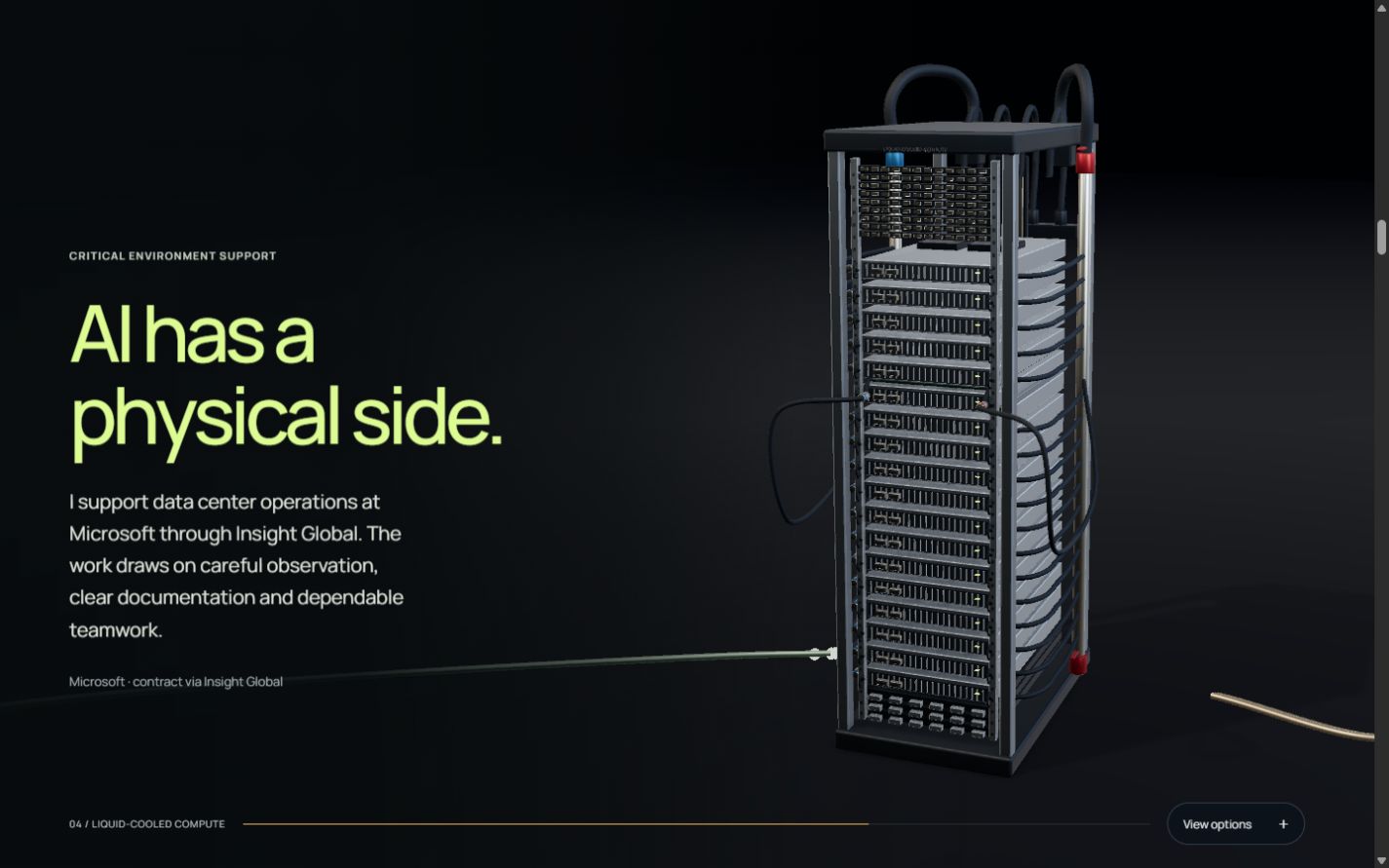
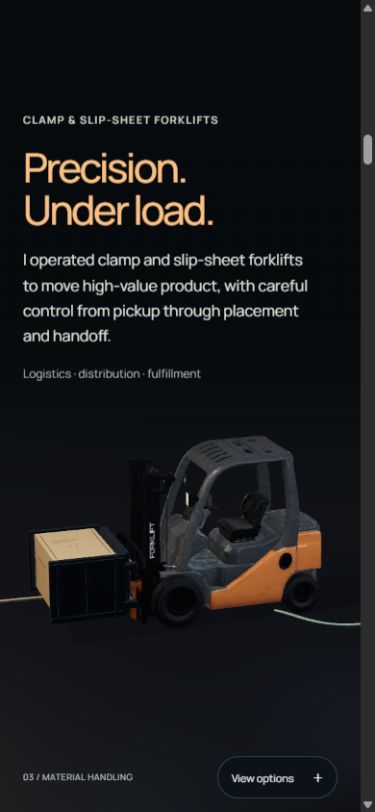

The complete rendered proof, geometry comparisons and performance evidence are preserved in the project audit. Physical Galaxy S24 qualification and visual sign-off remain open. Existing public review access is unchanged; Cat upstream rights remain unverified.
Preserved preceding checkpoint
The selected camera route is retained, with arc-length sampling for more even travel. The route now continues through the refrigerator, a loaded carton-clamp forklift, the compute rack and its opening service tray, then into the circuit board and software. Scroll forward or back to reverse every move.
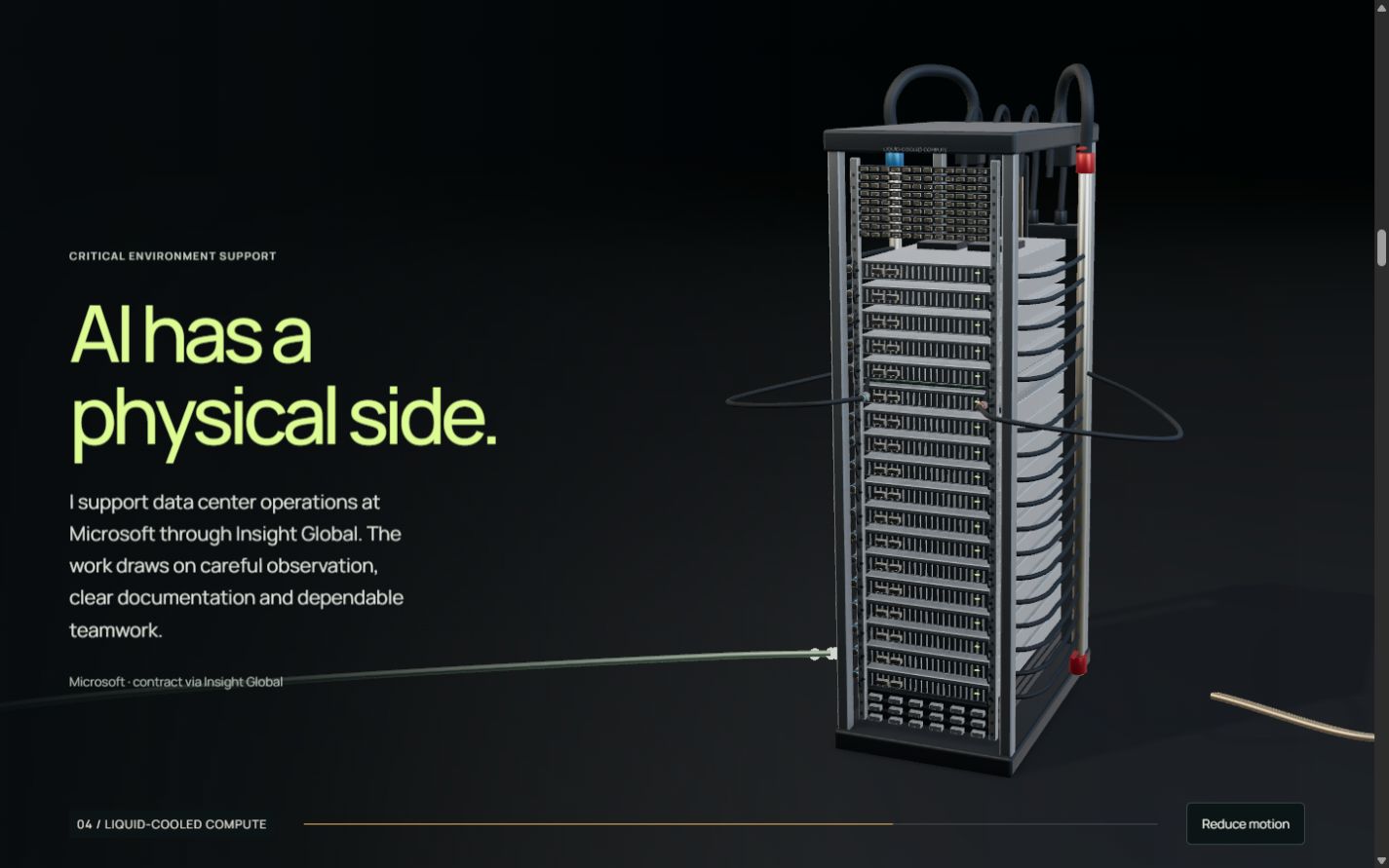
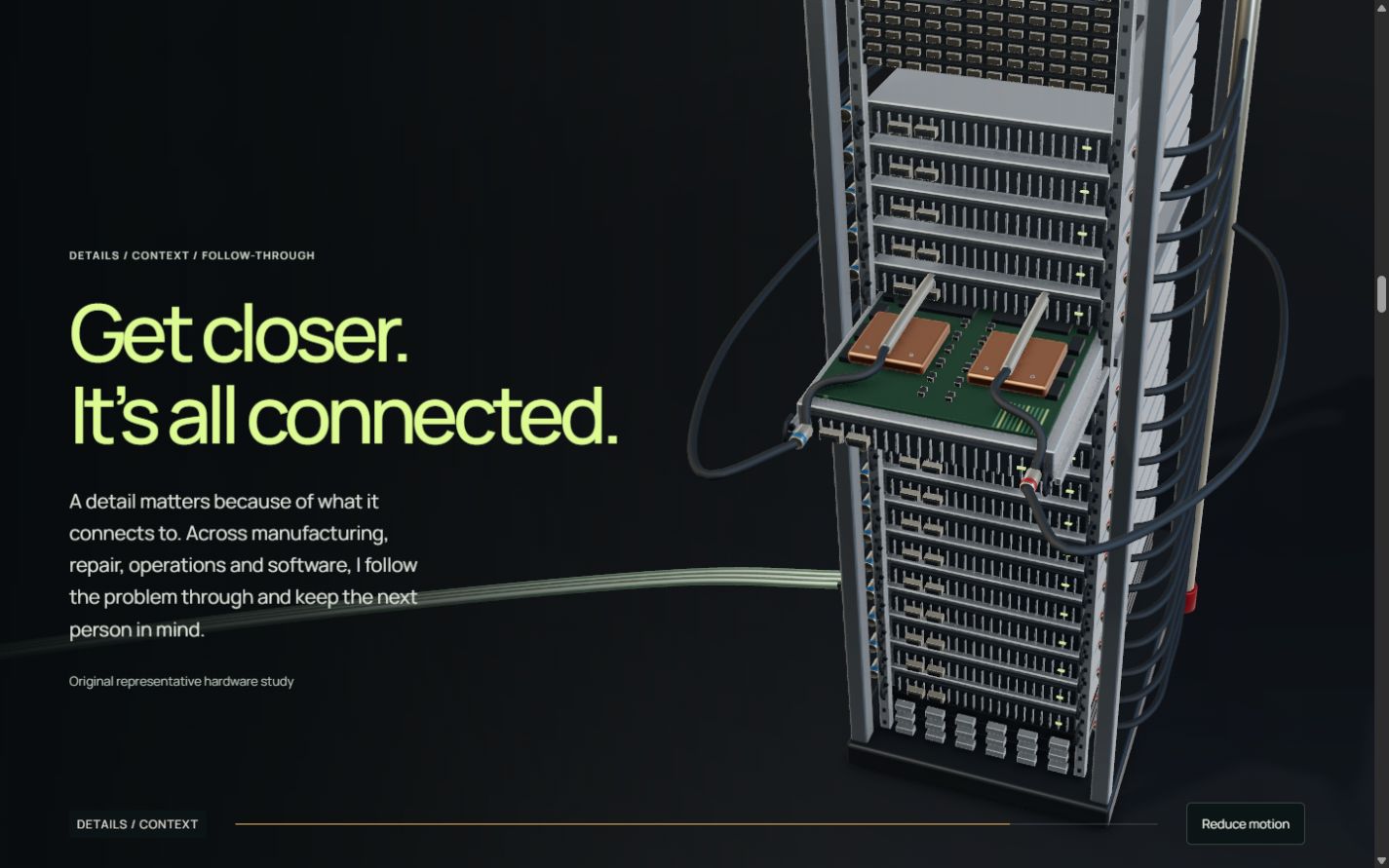
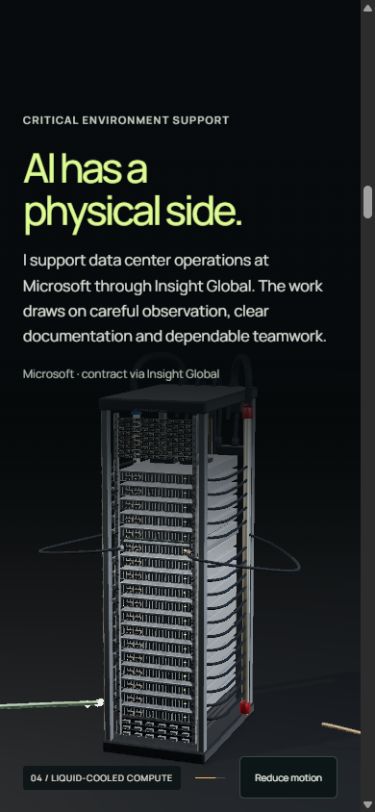
Final audit and refinement
Rack & Role now combines its actual archived interface with a four-part account of data acquisition, role evidence, grounded AI and hiring operations. Historical measurements are explicitly attributed and separated from the archive’s displayed count.
The equipment pass adds supported tray rails, connected service fittings, hose slack with verified clearance and bend geometry, and a more coherent clamp attachment. Transport compression preserves every Cat triangle index and original position byte. All earlier study files remain preserved.
Refining the selected direction
Broader studio reflections, brushed-metal shading, filtered paint finish and a higher-resolution desktop environment refine the existing composition. Forklift normal and material maps now retain the original source pixels losslessly. The earlier top-cover hinge shown in this checkpoint is superseded by the up-and-behind mechanism above; the rack’s flexible leads retain their stationary endpoints during inspection. The camera follows the same route with more even curve sampling and a smoother restart from rest.
Motion and fallbacks
Native scroll controls the camera and HTML chapters together. The scene has settled reading intervals, reversible inspection moves and one demand-driven render owner. When motion is reduced or graphics fail, all seven chapters remain readable. Actual tests covered fast/reverse navigation, 390-pixel and 320-pixel widths, landscape, missing geometry and graphics-context loss/restoration. Idle frame counts stayed unchanged. This does not establish physical-phone, Safari or Firefox performance.
Credits and review boundaries
Equipment artwork is representative, not workplace evidence. Exact career hardware and installation specifics have been removed from the active copy and regenerated captures. The original records remain preserved locally.
The asset credits and license review identify source authors, modifications and the unresolved upstream-rights qualification for the Cat model. This is the existing public review under explicit owner authorization. That authorization does not establish the unresolved upstream redistribution grant.
Asset and capability record · Preserved revision 05 · All earlier studies